
On Taking Time
Fava Beans

Time is a tool of colonization. We can get hot and heavy and graphic on the intellectual side of things about that, BUT coming from a long line of indigenous, loud Algerians when someone says “they’ll be there in 15 minutes,” we all know that’s not true. 15 minutes could mean three hours, or it could mean thirty-five minutes or the next day. I think that’s just one way of fighting “the man.” The man in question being whiteness and capitalism.
Colonization is how I found myself standing outside of Napoleon's extremely haunted Chateau in France on a Sunday afternoon at 4 pm. Not a single soul around but my parents, the ghosts, and a stubborn but very cute Chelten pony. My very white mother insisted that we show up early because the invite she preciously clutched in her hand read START 4 PM. The time was 3:50, and as I tried to get the attention of the stubborn Chelten, I realized that no one was actually going to be there until at least 6.
It was true; at 6:09 out of a cloud, a Raï band, the bride, groom, and the rest of my family and guests appeared. My family of proud Algerians carrying their legacy of fighting for liberation against the French by showing up to a Chateau in Versailles two hours late past the booking time and staying as long as they damn well pleased. In this case, that meant 10:33 AM. Yes, they danced till the sun rose sticking it to the small French man, “Do not tell us when to show up or when to leave this very haunted colonizer's chateau! He is dead, we are so alive and we shall revel in it with our freedom to celebrate.”
Perhaps as a mixed kid, you could say that not only did I grow up between cultures but that I grew up between time and expectations of time. My jida (my grandmother) always sat at the kitchen table looking out the window with a bowl of vegetables soaking in water. Slowly peeling them, holding them just right so she could cut them in her hands, each slice of a carrot falling just so into an empty bowl. She held mountains of fresh fava beans, taking the time to shuck them one after the other. Boiling, peeling, and then returning them to a pot to cook again.
For one who has never cooked fava beans before, you cannot eat a freshly shucked fava bean; they wear what I like to consider a “protective layer” of skin that when ingested is highly toxic. So one must shuck the bean and then boil the bean to soften the protective layer and then cool the bean down in an ice bath so it doesn’t get too cooked . Once you do all that you have to peel the protective layer of skin to reveal the bright luminous meat of the fava bean that then you get to cook again.
We always had my Jida’s version of berkoukes or couscous or cherchem on the stovetop. The way my Jida moved to complete these tasks was breathtaking to me, effortless, calming. It made me want to be her or at least closer to her.
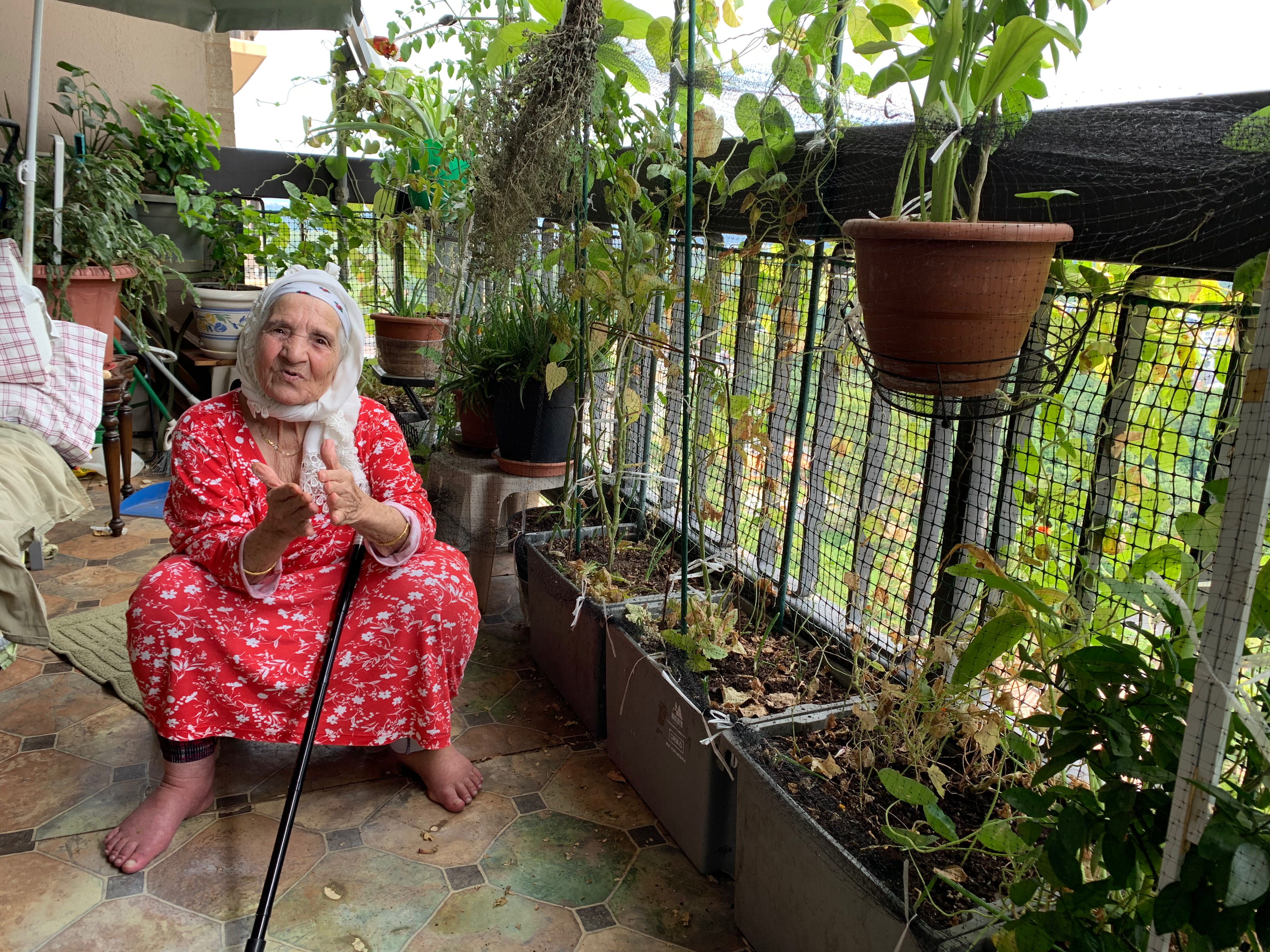
Image Description: Malik’s Jida, an old Algerian woman, with a white hijab, a red dress sits with a cane in her lap. She is outside on a balcony next to her garden. She is singing and clapping her hands.
Time was a religious experience for her. No matter what, my Jida would stop to pray five times a day: Fajr, Zuhr, Asr, Maghrib, Isha. I would sit in the living room watching her kneel, kissing her hands from her mouth to her head, bowing as “Allah Akbar” rang across the living room. Another moment of beauty and ritual. The day would stop, and prayer would occur.
My mother would come home from work, exhausted, and slam into the kitchen. Her bag on the table, my Jida would be gone by then having returned to her room in the basement of our house. My mother would look at the fava beans on the stovetop, declaring them “A waste of time” because they took so long to prepare. The shucking, the boiling, the peeling, then cooking them again. Though my mother was always the one to buy fava beans and bring them home to my Jida.
I didn’t cook fava beans for many years. I wanted to, but my mother's voice "fava beans are a waste of time" was stuck in my head. Then one day I saw them in the grocery store. A pile, fresh, bright green peering at me between the tomatoes and onions. I looked at them, “Do I have the time?” A million things to do… I found my hands wavering over the green pods, finding the beans mountainous and irresistible. I filled a bag and carried them home.
I was planning on doing other things with my day. Walking the dog, cleaning the bathroom, folding my laundry, doing something creative, meeting some friends for coffee, but instead I found myself softly in the kitchen. The sound of fava beans plucking into a metal bowl as my own hands steadily worked to complete the first step of shucking. I boiled water, I boiled beans and placed them in an ice bath watching the beans bob and melt my fun star-shaped ice cubes from the freezer. I then sat down and began the process of peeling. The thing about fava beans is that the more you peel the beans out of their protective layer, the fewer beans you seem to have. It took time to do this task. As I peeled, I looked out the window, watching a mourning dove coo on a tree branch in front of my kitchen window. I felt tension move out of my shoulders as my body relaxed into the task at hand.
De-colonization is the de-escalation of expectations for yourself. That in a day one must walk the dog, clean the bathroom, meet some friends for coffee, do something creative, fold the laundry, wash the dishes and that’s just in the first half of the day. On the day I cooked fava beans, I did not do a big creative project or clean the bathroom or wash all the dishes or go to meet friends for coffee. I did none of that; I only cooked fava beans. In the tradition of my Algerian ancestors, the next day—the next day I showed up for coffee.